🇫🇷 🇬🇧 🇪🇸
MiniBook of diagrams nº939
A precious companion for all those who enjoy practising Dien Chan with finesse.
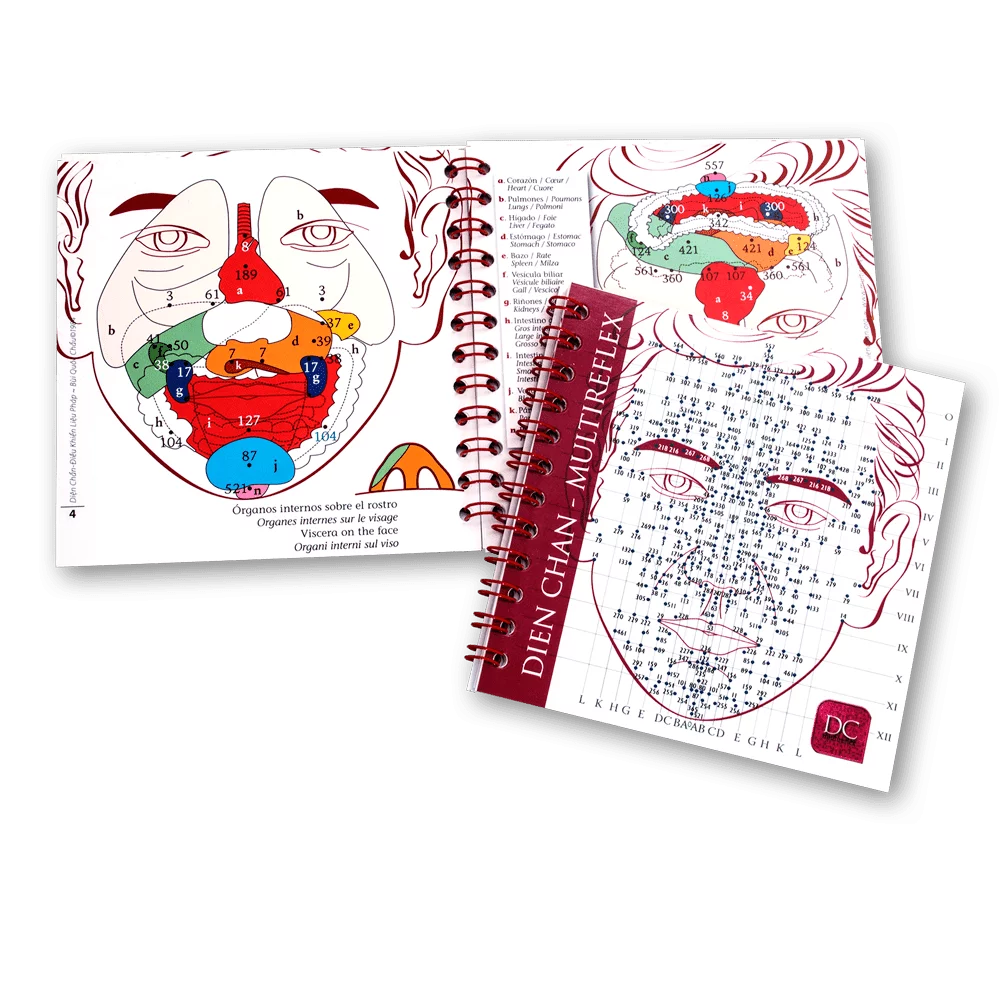
This colourful MiniBook brings together all the facial reflex diagrams, always at hand.
Compact, practical and elegant, it supports both the curious student and the experienced practitioner — in consultation, during training or while travelling.
It is easy to flip through, simple to explain, and quickly becomes the reference tool for understanding — and helping others understand — the correspondences of Dien Chan.
- Size
- 11 × 11 × 0,8 cm
- Materials
- paper
- Colour
- color
- Weight
- 45 g
📖 Description
Designed for quick consultation during a treatment, the MiniBook fits in the hand and can be kept anywhere: on your work table, in a bag, or even in the glove compartment — ready to serve whenever needed.
Its square format (11×11cm), robust spiral binding and high-quality colour printing on thick paper ensure a clear, fluid and long-lasting reading experience.
Each diagram shows the constellation of bqc·points associated, making it easier to visualise and memorise the energetic architecture of the face.
The texts are offered in French, Spanish, English and Italian, for a truly international view of the method.
A genuine tool for progressive learning: the more you open it, the deeper your understanding becomes.
🖐 How to use
The two covers of the MiniBook present the full map that allows you to locate facial bqc·points quickly.
You will also find a page dedicated to correspondences with the cranial nerves — very useful to establish links between structure, innervation and reflex zones.
This immediate access to key landmarks makes the MiniBook particularly practical in consultation.
💡 Tips
Begin with the reflex diagram that appears the clearest or most suitable for the area concerned.
Then observe the body’s response: comfort? relaxation? warmth?
Do not hesitate to explore a second diagram — sometimes another cartography will resonate better with the person’s energetic terrain.
The richness of Dien Chan lies in this flexibility of adaptation, in the practitioner’s ability to alternate, test and feel.